 Register / Login



Juicers – Some Common Myths
Juicer Facts And Fictions
UK Juicers is committed to providing our customers with useful information that sticks to the facts. We don’t offer information or make claims that can’t be borne out by objective testing. Unfortunately that’s not a principle that is very widespread in the world of sales talk on the internet and we’d like to help you sort the facts from the quackery.
Juicing is growing rapidly as a lifestyle choice and more and more people are researching online to inform their choices when selecting products. At the same time manufacturers are in a race to persuade people that their juicer is the best offering, pointing out ‘new features’ that supposedly deliver increasingly better results. Sometimes it’s not easy to tell what features are genuinely beneficial and what is just marketing hype.
If you are researching buying a juicer there are quite a few sources of information on the web that promote pseudo-science to try and persuade you that one particular model is the ultimate ‘must have’ machine. Here are some of the unproven claims that you will probably come across.
High Speed Centrifugal Juicers Destroy Enzymes
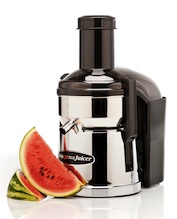
Centrifugal Juicers DEFINITELY DO NOT DESTROY ENZYMES. This is pure fantasy and it’s become a great marketing ploy for some people who sell masticating juicers. Even we used to accept this unproven scare-mongering, because it was so widely repeated by eminently respectable people. Max Gerson contributed to this myth with his claims about the oxidation of enzymes by Centrifugal Juicers but although the Gerson Therapy is widely respected, no scientific evidence supporting the idea that Centrifugal Juicers destroy enzymes is available.
Basic research published by Michael Donaldson PhD has shown that there is significant enzyme activity in the juice from various models of centrifugal juicers. Some websites claim that the high speed friction in a centrifugal juicer heats the enzymes and kills them. Some claim that the high speed tears the enzyme molecules apart. This is all unproven. For a juicer to destroy enzymes the resulting juice would have to be heated well above blood temperature and no juicer we’ve encountered does that.
 Masticating juicers do extract greater amounts of some nutrients, so if getting the best juice quality is number one priority you can find out about the differences between masticating juicers in our choosing a juicer section. But nobody should be scared into spending hundreds more on a masticating juicer by the myth that centrifugal juicers produce juice with no enzymes. Centrifugal juicers are the most common and popular choice and they offer great health benefits. A very user friendly example of this type of juice extractor is the Sage Nutri Juicer Cold Plus. The most popular feature of good quality centrifugal juicers is that they are quick and easy to use and a small compromise in overall performance is often acceptable in a busy household where juicing needs to happen with greater speed and convenience.
A Slower Juicer Gives Better Juice and More Juice
This is sort of true, but people then get caught up in a search for the slowest turning juicer in the belief that it will give more nutritious juice. Twin Gear and Single Auger Masticating Juicers work better at low speeds because of their juicing action. All masticating juicers give a more nutritious juice by breaking down the fibre of the fruit and vegetables more thoroughly, releasing more nutrients into the juice. They do this because of their chewing and grinding action, not because of how slowly they must work. If you had to choose between a model that turns at 100 RPM and one that turns at 50 RPM will the slower one give more nutritious juice? No, because nutrient extraction is determined by more than speed alone.
There are two main factors that determine juice yield and juice quality. First there is the degree to which the ingredients are broken down by the juicing process and second is the force used to separate the juice from the pulp. Masticating juicers that are capable of juicing greens and wheatgrass as well as other ingredients are able to do so because they break down these fine leaves thoroughly by passing them through a smaller gap between the juicing parts. To do this effectively these juicers have to operate slowly. The speed is a mechanical and technical limitation of their design – it is not a key feature!
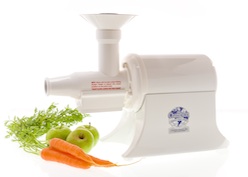
The quantity of juice extracted is determined by the pressure or force used to extract it. In masticating juicers this force is created by the back pressure from the pulp outlet and the fineness of the juice filter. In a centrifugal juicer it’s the rotational speed that creates the centrifugal force to separate out the juice. Even the humble centrifugal delivers a very high yield of juice from most hard fleshed ingredients. In most cases the difference in juice yield, just like the difference in juice quality, is not huge. Low speed juicers may be a bit more versatile, but in most cases there is a small additional price to pay in the time you spend juicing. If you are choosing a low speed juicer, whether is turns at 40, 80, 90 or 180 revs is not going to be the most significant factor in determining juice yield and juice quality.
Twin Gear Juicers with Bio-Magnets Improve Juice Quality and Shelf Life
This unproven claim is made by juicer manufacturers who have ‘bio-ceramic magnets’ inside the gears of their twin gear juicers. They say that the effect of these magnets is to increase the longevity and “vitality” of the juice. Unfortunately there are no credible scientific studies that we can find on the topic of bio-magnets and their effects on food and health.
Twin gear machines do actually offer a more nutritious juice than almost all other methods. They do this because they break down plant fibres more thoroughly than other juicers and release the nutrients under higher pressure. We’re not of the opinion that work better because of bio-ceramic magnets performing some mystical jiggery pokery in the juice molecules!
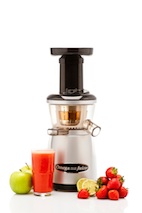
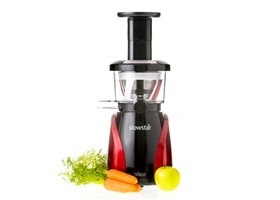
A Twin Gear Juicer can be a good choice for people who are aiming primarily for maximum nutrition from their juicer. For this reason they are often recommended by nutritional therapists to people combatting ill health. Green Star Juicers are popular choices. For a tiny compromise in results consumers can make a huge saving in time spent by going for one of the newer type Vertical Slow Juicers which turn the traditional auger type juicer into a much more user friendly device – one that is perhaps easier to live with than a Twin Gear model.
Other Misleading Claims
In the rush to present supposedly new features that will set one juicer apart from the crowd, manufacturers come up with all sorts of meaningless terms and bogus data. Vague and ill-defined terms like “90% more nutrient extraction than other juicers”, “80% more enzymes” or “50% less pulp” are meaningless unless proper independent testing has verified such statements. More or less than what?
Lots of single auger juicer brands are now moving towards using GE Ultem material in the augers, offering the alleged advantage that this material is ‘up to 8 times harder than other augers’. That sounds like a good feature but to some extent its offering a solution to a juicer problem that doesn’t exist. So far we have had very few problems with juicer augers that are made from other materials, so although it sounds like a plus, is a GE Ultem auger a big step forward? It sounds reassuring and perhaps reassurance that you are buying the best materials does have a value.
Some manufacturers state that the auger has a “dual” or “triple stage pressing action”, because of the variations in the profile of the auger and juicing screen. You might expect that more pressing ‘stages’ means more juice but in reality the difference in juice yield from different auger juicer brands is relatively small. When manufacturers are continually trying to gain an edge on the competition, consumers are having to sift through more and more new ‘must have features’ so that they can have confidence in their buying choice. Arbitrarily dividing up the juicing process into more ‘stages’ than your competitor is kind of like gents razor manufacturers continuing to add more blades – after a certain point there is no genuine advantage.
Another popular point of comparison for different brands is the length of the product warranty. The logic behind this is that the longer the warranty, the longer the juicer will last and therefore the perception is that the quality of the machine must be better. This is categorically not so. A warranty covers for faults and defects but it doesn’t cover for wear and tear or accidental damage. Long warranties mostly cover the motor only and most induction motors are very reliable in any case, regardless of which brand you choose. The length of the warranty period doesn’t necessarily reflect the build quality or reliability of the machine; it reflects how far the brand will go to win your confidence, and the cost of supporting the warranty is usually built into the juicer price.
When you are reading a list of product features it’s not always easy to separate out the factors that make a real difference to the user experience. We prefer to help people choose on the basis of facts and steer clear of hype and pseudo-science. If you need any help cutting through all the jargon please don’t hesitate to contact us for advice – and if you come across any other bits of nonsense about juicers on the web that isn’t mentioned above, please let us know and we will add your comments below!